The SHINE Research Project Policy Brief
29 October 2025
The social housing sector has a growing opportunity to transform homes in Ireland into healthier, more sustainable spaces through environmental sensors—but progress remains limited. What is prohibiting the sector from catalysing this environmental shift in social homes?
This policy brief is an overview of the SHINE project’s output during its first stages, from 2023 to 2025. The SHINE Research Project is hosted by Dublin City University‘s School of Law and Government and the School of Electronic Engineering. SHINE’s funding is coordinated and administered by Taighde Éireann – Research Ireland, with Clúid Housing as its Societal Impact Champion. SHINE is a proud recipient of the National Challenge Fund, established under the government’s National Recovery and Resilience Plan (NRRP) and funded by the EU’s Recovery and Resilience Facility.
The Problem
As Ireland faces a widespread housing crisis, unfortunately, this is not the sole issue affecting the housing sector.
The social housing area faces considerable challenges regarding Indoor Environmental Quality (IEQ) and housing maintenance practices. These lead to the quick decline of housing quality because of structural issues, showing that these facilities were built unprepared for future long-term problems like climate change (Reponen et al., 2014).
These issues are now commonly recognised in the sector as directly linked to poor health outcomes and heightened inequalities in Ireland (Haidar & Bahammam, 2021). Research shows a staggering 24% of households in Ireland experience poor home IEQ (Healthy Homes Ireland, 2023), contributing to issues such as respiratory conditions, especially among vulnerable groups like children, who face a 50% increased risk of asthma linked to dampness and mould (Holden et al., 2023).
The ageing housing stock and poor socioeconomic factors often rely on inefficient heating methods, further exacerbating these issues and increasing mould growth and poor indoor air quality (IAQ) (Creane et al., 2024). As a result, approximately 1,600 premature deaths in Ireland are expected annually due to pollutants from indoor solid fuel sources (EPA, 2024), illustrating the severe public health risks connected to unhealthy housing conditions.
Despite the government’s ‘Housing for All‘ plan aiming to enhance housing supply and affordability, concerns regarding IAQ and IEQ remain secondary (link soon). Maintenance policies from social housing managers, such as Local Authorities (LAs) and Approved Housing Bodies (AHBs), currently lack the necessary resources to resolve such systemic issues, poor ventilation, and thermal inefficiency due to various problems already identified in previous research and explored further in our investigation.
The SHINE Research Project
The “Sustainable Homes Integrating Non-Intrusive Environmental Sensors” (SHINE) project aims to enhance IAQ and IEQ in social housing. This is achieved through two main approaches: providing policy recommendations and developing a non-intrusive environmental sensor to promote a healthier environment and improve health outcomes for social housing residents.
The project’s outcomes are informed by comprehensive data gathered from one-on-one interviews with 28 stakeholders in the social housing sector. These stakeholders represent various entities, including Approved Housing Bodies (AHB), Local Authorities (LA), government organisations (some of which work with AHBs and LAs), private companies, non-profits, advocacy groups, professionals in the surveying and construction industries, and social housing tenants. The insights provided by these stakeholders have guided the design of a sensor that addresses the diverse needs and perspectives of all parties involved in the sector.
What We Discovered
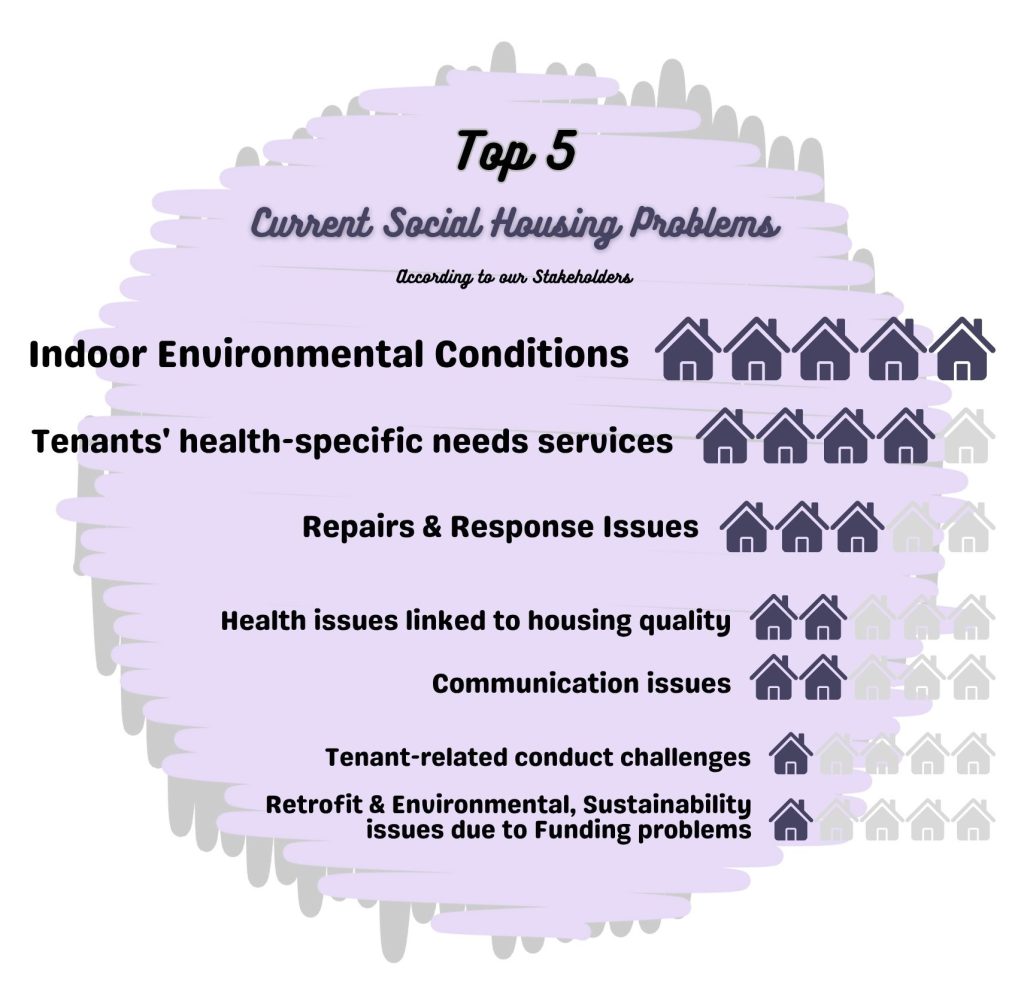
Top Five Current Challenges in Social Housing as Identified by SHINE’s Stakeholders
#1. Indoor Environmental Conditions, such as Mould, Damp, Condensation, Insulation, Ventilation Issues
Various factors contribute to these issues, improper use of machines at homes, aged properties, structural integrity concerns, water ingress defects, poor machine installation, high energy costs driven by inflation, latent defects, cold bridging, insufficient thermal insulation, air pollution, including tenants’ indoor lifestyle and adverse environmental conditions.
Stakeholders stated that it is important that tenants should not be blamed for these problems. For example, some observed cases of mould in properties continued to occur despite cleaning efforts with antifungal solutions and guidance provided by the housing bodies. It became clear that these measures were insufficient.
Key findings:
- Primary Issues: Insulation and ventilation.
- Replacement Not Sufficient: Simply replacing problematic systems (heating, windows, doors) isn’t a long-term fix; deep retrofitting is necessary.
- Structural Issues: Structural problems, not tenant behaviours, are at the core of these challenges.
- Tenant Efforts: Many tenants report that they do their part to ensure proper ventilation and address mould, yet problems persist.
- Expert Insights: Stakeholders highlighted studies showing that the age of properties, local climate conditions, climate change, poor Building Energy Rating (BER) properties, and inadequate housing quality/design for ventilation significantly contribute to these issues.
#2. Tenants’ Health-Specific Needs Services
Most AHBs primarily address general needs, leading to a significant gap in services tailored for tenants with specific needs. This results in the following issues:
- Lack of adapted housing and appropriate support services.
- AHBs often lack the expertise to adequately support tenants with specific needs, such as mental health issues among older individuals.
- Many older tenants wish to age in place but are at risk of being transferred to nursing homes due to societal and political factors, including inflation, rising rent and house prices, inadequate pensions, difficulties in maintaining independent living, and potential nursing care needs due to health decline.
- Lack of prioritisation in housing allocation for individuals with severe medical conditions, with most resources and attention being directed towards issues related to drug and alcohol addiction.
- The integration of IoT technology and marketplace solutions typically focuses on general needs rather than niche markets, such as those catering to specific disabilities, due to perceived low profitability.
#3. Repairs and Response Issues
Repairs emerge as a major concern, as gathered from tenant complaints and satisfaction surveys. The system faces organisational and management challenges, primarily due to insufficient resources for quick responses.
Communication Breakdowns: There are significant communication issues between landlords and tenants. Tenants often do not receive callbacks regarding repair requests, leading some to attempt repairs themselves or stop calling altogether.
Slow to respond: Some tenants felt their concerns were trivialised, with advice to simply clean their properties with anti-mould materials.
Tenants often perceive long waiting times for repairs as poor customer service, not realising that the response system categorises issues based on urgency, which adds to their frustration.
Capacity Challenges: Landlords are inundated with complaints, leading to overwhelmed response systems.
Contractor Limitations: When repair contractors visit properties, tenants often raise new issues that cannot be addressed due to the contractor’s fixed daily schedule, causing additional delays.
Access Issues: Non-access to properties or tenants being unavailable when contractors arrive leads to repair rescheduling, which can escalate issues if left unresolved.
#4. Health Issues Linked to Housing Quality
There is a significant connection between poor housing conditions and various health problems, particularly affecting vulnerable individuals.
Public Health Concern: Heating and warmth in housing should be treated as a public health issue, yet current policies often overlook this connection.
Lack of Investment: The government is not investing adequately in the intersection of health and housing. More push is needed for this to happen, as investment in health in housing currently does not yet appear economically beneficial.
Housing Providers’ Focus: Housing providers tend to concentrate on housing-related funding and regulations, neglecting health considerations within their services.
Potential Health Risks: Poor housing conditions can lead to respiratory issues (like asthma), increase winter deaths among older people, impact the immune system, aggravate pre-existing health conditions, and expose individuals to harmful pollutants.
Homelessness Impact: A lack of adequate housing contributes to homelessness, which can be traumatic for children and adversely affect their mental health.
Specific Health Concerns for Older People: Issues such as mould infestation and inadequate insulation are directly linked to health risks, including increased mortality during winter.
Tenant Experiences: Those living in poor housing conditions reported various health issues, including chronic sore throats, chest problems, lung issues, panic attacks, suicidal ideations, and stress-related skin conditions.
#4. Communication Issues
A significant problem arises when communication between tenants and landlords is not effectively managed. This issue is mostly observed during repair and maintenance management. For example, the tone of communication can lead to tenants feeling defensive and emotionally attached.
Tenants find it challenging to reach out for help to their landlords due to various factors, including:
- Long response times or no responses at all.
- Transition from personal interactions to impersonal, business-like communication.
- Inconsistent tenant officers and staff changes.
- Insensitive comments from officers, leading to feelings of blame for residential issues.
- There is a notable power imbalance between landlords and tenants that affects communication.
Housing bodies encounter the following communication issues with their residents:
- There are specific challenges in teaching vulnerable groups, such as older tenants, how to use complex home machines and systems.
- Insufficient information on the maintenance of ventilation systems.
- Ineffective communication regarding how tenants can manage their equipment.
- Inadequate information was provided to tenants related to the response and repairs process, assistance with complicated machines, and overall communication strategies.
- The scattered nature of properties across the country, limited staff, and a focus mainly on property-related issues hinder effective communication and management.
#5. Tenant-Related Conduct Challenges
Our stakeholders acknowledge that tenant behaviour is not the sole factor affecting health and housing quality. However, several related issues can still be observed in the current social housing environment, such as the following:
Misunderstanding of Systems: Many tenants struggle with the proper use of ventilation machines and heating systems, resulting in inadequate heating, CO2 buildup, high bills, and mould or condensation problems.
Habits Contributing to Mould:
- Hoarding affects airflow, light, and heat distribution.
- Tenants often refuse to use clothes dryers due to high energy costs, leading to indoor clothes drying, which contributes to mildew and dampness.
Despite the attempts at behavioural and ventilation changes by tenants, mould continues to thrive due to structural problems, insulation issues, and poor repair quality.
Ineffective communication between tenants and landlords or management can lead to inadequately addressed repairs, with some issues being rescheduled or unresolved.
Some tenants are hesitant to address mould issues, fearing infection from disturbing it, and may prefer relocation over tackling cleaning efforts.
#5. Retrofit & Environmental, Sustainability Issues due to Funding Problems
Funding Gaps: The Sustainable Energy Authority of Ireland (SEAI) provides funding for 50% of retrofit costs, but the source for the remaining 50% is often unclear, creating financial challenges among AHBs and LAs.
Limited Grant Coverage: Available grants focus on a narrow range of technologies, leaving some practical solutions, such as certain thermodynamic systems, unfunded.
CLSS Properties: Properties constructed between 1991 and 2009 do not qualify for any retrofit funding, further complicating the retrofitting efforts of aged properties.
Inadequate Resources for AHBs: Current funding and grants received by AHBs are insufficient to manage existing properties, deliver new housing, and simultaneously undertake retrofitting. The limited available debt further discourages private investment.
Need for Policy Change: There is a pressing requirement for policy adjustments that increase grant funding to alleviate financial burdens and support simultaneous housing development and retrofitting.
Economic Link Between Health and Housing: The argument is made that improved housing quality (warmer, more sustainable properties) correlates with better health outcomes. Health and housing must be addressed jointly for this connection to be recognised by the government.
Funding Grant Structure Issues: Recent changes by SEAI to a per-component grant system are seen as unsuitable, especially across different regions with varied needs.
Retrofitting of Historic Properties: Dublin City faces significant challenges in retrofitting older buildings to enhance their energy performance, highlighting the need for focused strategies in urban areas.
From Reactive to Proactive
A call to shift the maintenance approach in the social housing sector in Ireland.
The social housing sector is currently operating under a reactive maintenance model, addressing issues in its properties and for residents only as they are reported. This reactive approach can lead to problems worsening, potentially having adverse effects on residents before they are adequately addressed. For instance, if a resident discovers a growing mould infestation in a corner of their home, reports it, and receives a response after 20 days, there is a significant risk that the infestation may have already doubled in size and impacted both the resident’s health and their living environment before any maintenance intervention occurs.
Insights gathered by the SHINE project from stakeholders reveal that the common practice among AHBs and LAs in response to such issues is primarily to advise tenants to clean the mouldy surfaces with anti-fungal solutions and ensure proper ventilation. Some residents have taken matters into their own hands by hiring professional help, motivated by the understanding that they may not receive timely responses from their landlords. Others, however, report receiving the same discouraging advice, leading to frustration and disillusionment regarding their landlords’ support. Despite these efforts and some factual evidence indicating that structural issues contribute to mould problems (Rialto Rights in Action Group, 2010), the blame is frequently placed on the tenants.
The recent death incident in 2020 involving the death of two-year-old Awaab Ishak in Rochdale, UK, caused by respiratory issues stemming from mould exposure in a social housing environment, has prompted stakeholders to abandon the tenant-blaming narrative. They are now advocating for a more proactive approach to addressing mould issues within their housing stock. A proactive maintenance strategy involves identifying indoor environmental problems before they worsen, enabling both residents and maintenance teams to engage in timely interventions.
The SHINE project aimed to contribute to this transition by informing policy strategies for social housing authorities in Ireland. It seeks to help shift their property maintenance approach from reactive to proactive and to develop a technological tool, such as the SHINE sensor, that can assist in this transition. This sensor will support a proactive maintenance strategy by identifying and addressing problems before they escalate. The SHINE sensor can monitor air conditions in homes and can identify potential mould build-up through various elements, such as humidity levels and nitrogen dioxide (NO2) concentrations. This approach not only aims to reduce health risks among residents and repair costs for housing bodies but also minimises and ultimately eliminates energy inefficiencies in homes.
SHINE’s Solutions
SHINE aims to address these issues in Irish social housing by offering two key solutions: policy recommendations focused on enhancing indoor environmental quality and sustainability, and the development of the SHINE sensor: a non-intrusive environmental sensor system designed to promote a proactive maintenance approach with the involvement of residents.
Policy Recommendations
In our paper (link soon), our findings highlight two main areas to address to improve Irish social housing policies: the ongoing challenges in prioritising IEQ and sustainability at the national level, and the involvement of three main players in the new maintenance policy strategy to ensure changes in the sector.
The current hindrances to improving IEQ in Irish social housing are the lack of a clear national definition or standard for best practices and the focus on increasing housing stocks (Healthy Homes Ireland, 2023).
Ireland currently does not have a widely accepted definition of IEQ best practices, despite the serious health risks associated with indoor air pollution, such as premature deaths (EPA, 2023). While organisations like the WHO and EU provide guidelines for air quality, Ireland struggles to meet these standards and lacks specific parameters for measuring IEQ. This ambiguity hampers initiatives to link health in housing to ultimately develop effective policies and actions to address this issue.
The connection between housing and health, especially in old age, is significant; poor IEQ affects not only vulnerable populations but can also harm the health of previously healthy individuals (Oswald et al., 2007). The neglect of IEQ in social housing reflects a misalignment between urgent health and environmental issues and current policy priorities.
Other prioritised initiatives, such as Housing for All, keep the sector occupied with increasing the country’s housing supply rather than enhancing the sustainability features of existing homes. Furthermore, a large share of government funding is allocated to this project, leaving minimal resources for improving homes’ IEQ.
Additionally, neglecting IEQ impacts environmental sustainability through inefficient energy use, social sustainability by harming vulnerable groups, and economic sustainability by increasing long-term healthcare and maintenance costs.
Our stakeholders emphasised the urgent need for policy reforms. One recommended solution is to adopt a holistic approach in the proactive maintenance policy, which involves the three key agents of change: policymakers, the construction supply chain, and social housing residents. Collaborating among these groups can ensure lasting improvements. For instance, involving residents in the policy decision-making process not only provides them with a platform to express their concerns but also allows housing organisations to identify effective solutions tailored to the diverse needs of their tenants.
The SHINE Environmental Sensor
One of SHINE’s main concerns is addressing low-cost environmental sensors and data privacy concerns for residents in smart housing environments. While these sensors can provide valuable insights into living conditions and energy efficiency, they also pose significant data privacy risks, as sensitive information can be collected and shared without users’ full understanding or control. Reports indicate that users often encounter complex data privacy agreements, which further complicate their ability to safeguard their personal information (van der Schyff et al., 2023). The concern is heightened by the idea that raw sensor data can be analysed and combined with external datasets, increasing the risk of de-anonymisation and potential misuse by third parties (Kröger, 2019).
In response to these privacy concerns, the SHINE team has developed a sensor design methodology that prioritises user privacy while maintaining the functionality of the system. Using edge computing for data analysis reduces unnecessary data transmission, thus enhancing user control over their sensitive information (Fei et al., 2023). The proposed system encompasses a non-intrusive sensor suite that continuously monitors various environmental factors within social housing, generating actionable insights for residents. Reports are designed to offer transparency, allowing users to choose what information, if any, to share with external entities like the residents’ housing authorities.
Ultimately, this technology aims to empower residents and social housing management by providing tools that enhance understanding of critical living conditions while navigating the complexities of data privacy. The outcomes are expected to inform policy interventions and promote the adoption of smart technologies in social housing contexts, enabling stakeholders to address challenges relating to health, well-being, and environmental sustainability (Cali et al., 2023).
Read more here: “A Privacy-focused Data Solution for Understanding and Improving Indoor Environmental Quality in Social Housing From the SHINE Project”, presented at the Data for Policy 2025 conference at The Hague, Netherlands.
The diagram below shows SHINE’s blueprint of how the sensor works, from detecting and analysing home environmental data to sending this information on to the residents’ housing body for immediate response.

What’s Next?
Potential challenges that may arise during the upcoming phases of the project.
Our stakeholders have identified several potential challenges that the project may encounter as we move from piloting the SHINE sensor to its actual implementation. These concerns range from fostering resident cooperation to addressing data privacy issues. Here are the key challenges we will need to navigate in the upcoming phases of the project:
#1. Resident’s Cooperation
How can we effectively communicate the benefits of having the SHINE sensor in residents’ homes and encourage a proactive maintenance approach in collaboration with their landlords?
#2. GDPR and Data Privacy Concerns
How can we assure residents that our practices are GDPR-compliant? What measures can we put in place to prevent landlords from misusing the data?
#3. Sector-Wide Issues
Who will take responsibility for addressing the problems identified through the data collected from the sensor?
#4. Residents’ Health Conditions
How can we ensure that our solutions are inclusive and meet the general and specific needs and requirements of social housing residents?
#5. Residents’ Lifestyle and Behaviours
How can we promote lifestyle changes that align with sustainability and improved IEQ practices among residents? What strategies can we implement to ensure these changes have a lasting impact?
#6. Sensor-Related Concerns
Is there a genuine need for the SHINE sensor? How can we design the SHINE sensor to be non-intrusive and cost-effective?
Stay tuned for the second phase of SHINE, where we will harness citizen science by actively engaging social housing residents. Their participation will be key in evaluating the effectiveness of the SHINE sensor in addressing IEQ and IAQ issues in social homes. This valuable input will help shape policy recommendations aimed at implementing a proactive maintenance approach across the sector.
Resources
Calì, D., Matthes, P., Huchtemann, K., Streblow, R., & Müller, D. (2015). CO2 based occupancy detection algorithm: Experimental analysis and validation for office and residential buildings. Building and Environment, 86, 39-49. https://doi.org/10.1016/j.buildenv.2014.12.011
Creane, D., Hayes, C., O Ciardha, D., Smith, S. M., Campbell, A. & Mc Carthy, N., (2024). Health data to support local communities, 1, 1 – 12. Retrieved from https://www.tara.tcd.ie/handle/2262/104420.
Environmental Protection Agency (EPA). (2023). Air quality in Ireland 2022. Retrieved from https://www.epa.ie/publications/monitoring–assessment/air/air-quality-in-ireland-2022.php.
Fei, W., Ohno, H., & Sampalli, S. (2023). A systematic review of IoT security: Research potential, challenges, and future directions. ACM computing surveys, 56(5), 1-40. https://doi.org/10.1145/3625094
Haidar, E. A., & Bahammam, A. S. (2021). An optimal model for housing projects according to the relative importance of affordability and sustainability criteria and their implementation impact on initial cost. Sustainable Cities and Society, 64, 102535. https://doi.org/10.1016/j.scs.2020.102535.
Healthy Homes Ireland. (2023). OUR PLACE: Towards Healthier Greener Homes. Retrieved from https://www.igbc.ie/wp-content/uploads/2023/05/2.-HHI-Report_Final_Digital.pdf.
Holden, K. A., Lee, A. R., Hawcutt, D. B., & Sinha, I. P. (2023). The impact of poor housing and indoor air quality on respiratory health in children. Breathe, 19(2). https://doi.org/10.1183/20734735.0058-2023.
Kröger, J. (2019). Unexpected inferences from sensor data: a hidden privacy threat in the internet of things. In Internet of Things. Information Processing in an Increasingly Connected World: First IFIP International Cross-Domain Conference, IFIPIoT 2018, Held at the 24th IFIP World Computer Congress, WCC 2018, Poznan, Poland, September 18-19, 2018, Revised Selected Papers 1 (pp. 147-159). Springer International Publishing. https://doi.org/10.1007/978-3-030-15651-0_13
Oswald, F., Wahl, H. W., Schilling, O., Nygren, C., Fänge, A., Sixsmith, A., Sixsmith, J., Széman, Z., Tomsone, S., & Iwarsson, S. (2007). Relationships between housing and healthy aging in very old age. The Gerontologist, 47(1), 96-107. https://doi.org/10.1093/geront/47.1.96.
Reponen, T., Levin, L., Zheng, S., Vesper, S., Ryan, P., Grinshpun, S. A., & LeMasters, G. (2013). Family and home characteristics correlate with mold in homes. Environmental Research, 124, 67-70. https://doi.org/10.1016/j.envres.2013.04.003.
Rialto Rights in Action Group. (2010). Report on The First Monitoring of housing conditions In Dolphin House. Retrieved from https://www.canaction.ie/wp-content/uploads/2023/03/first_monitoring_report_september_2010.pdf.
van der Schyff, K., Foster, G., Renaud, K., & Flowerday, S. (2023). Online Privacy Fatigue: A Scoping Review and Research Agenda. Future Internet, 15(5), 164. https://doi.org/10.3390/fi15050164
 SHINE
SHINE 